Crystals vs. Gemstones: What's the Difference and Does It Matter for Wellness?
Stand in a well-stocked crystal shop and you will see bowls of tumbled amethyst labelled as crystals, a locked cabinet of faceted stones called gems, and a chunk of lapis lazuli that is, strictly speaking, neither. The words get swapped around constantly, and most of the time nothing goes wrong. But knowing where the line falls helps you read a label, judge a price, and pick the piece that suits what you actually want to do with it.
Here is the difference in plain terms — and why it matters far more when you are spending real money than when you are sorting stones on a windowsill.
A crystal is a structure; a gemstone is a product
A crystal is defined by how its atoms sit: in a repeating three-dimensional pattern. That internal order is why quartz forms points, why fluorite forms cubes, and why pyrite turns up as those neat golden blocks people mistake for gold. Anything with that lattice arrangement is crystalline, whether it is the size of a fingertip or a single grain inside a rock.
A gemstone is a different category altogether. It describes material selected and usually cut and polished for wear or display, chosen for beauty, durability and rarity. Most gemstones are minerals, but not all: pearl, amber, jet and coral are organic. Opal and obsidian are not crystalline in the strict sense at all — opal is a mineraloid, obsidian is volcanic glass.
So the short version: a gemstone is a material put to a purpose, and that material often happens to be a mineral with a crystal structure. A "crystal" in a shop is usually just a piece of stone you can hold.
Where the labels get loose in practice
One mineral, several names
Mineralogists name the species; the trade names the colour. Corundum becomes ruby when it is red and sapphire in almost any other colour. Beryl covers emerald, aquamarine and morganite. Quartz covers amethyst, citrine, smoky quartz and rose quartz. When you are buying, the species matters more than the pretty name, because it tells you hardness, care needs and roughly how common the material is.
Rocks, glass and tumbled stones
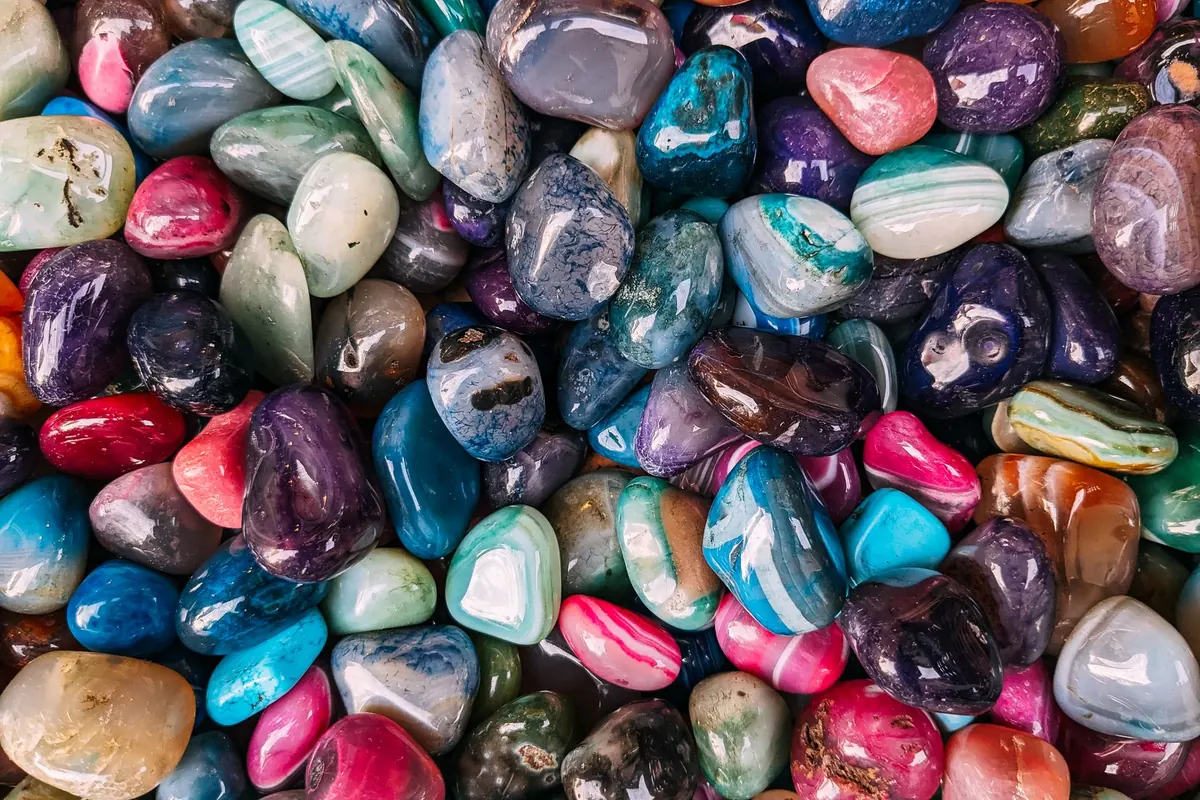
Lapis lazuli is a rock — a mix of lazurite, calcite and pyrite — not a single mineral. Tumbled stones are usually aggregates of countless tiny crystals rather than one crystal. Moldavite is a natural glass. Sell them all as "crystals" and a purist will flinch, but in a wellness context the word has quietly come to mean "natural stone, sold for its properties."
Grading: judged by different standards
Gemstones are graded against the four Cs: colour, clarity, cut and carat weight. A gem laboratory looks at how saturated the colour is, how free of inclusions the stone is, how well the facets are placed, and how much it weighs. In higher-value stones, a report from an independent gemmological laboratory is normal and worth asking for.
Crystals sold for wellness are rarely graded that way. Instead you see descriptions of formation, size, lustre and how the piece photographs. The strange part is that the qualities are almost opposite. A gem cutter wants a clean lump with no visible flaws so it can be faceted. A mineral collector or crystal buyer often prizes the flaws — a phantom, an inclusion, a perfectly terminated point that cutting would ruin.
Price: what you are actually paying for
Prices in both categories move on the same handful of factors: rarity of the material, colour saturation, clarity, size, quality of cut or polish, whether the stone has been treated, and how traceable the supply is.
A clean, well-cut aquamarine costs far more per gram than a rough chunk of the same mineral, because someone cut away most of the rough to get there. A dyed howlite bead will always be cheaper than turquoise, which is why it is so often sold as turquoise to buyers who do not ask. Treatments shift value in both directions, and heating, irradiation, dyeing, oiling and filling are all common. Disclosure of them is a reasonable thing to expect.
Two words worth knowing:
- Synthetic — the same material made in a lab, with the same chemistry and structure. Not fake in a chemical sense, but it should be labelled as synthetic.
- Simulant — a different material imitating the look, such as glass sold as ruby. Fine if labelled, frustrating if not.
If you are spending serious money on a faceted stone, treat it like any other significant purchase: buy from someone who will put the description in writing, ask about treatments, and expect an independent report on anything high value. If you are unsure, take advice from a qualified gemmologist or valuer before committing.
Does the label change the energetic claims?
Not much, on the whole. Most traditions that assign properties to stones do so by mineral — amethyst, rose quartz, black tourmaline — regardless of whether the piece is rough, tumbled or faceted. A polished stone is still the same material. What changes is how it behaves in your hand. A point is useful for directing and placing; a flat palm stone sits comfortably in meditation; a faceted stone throws light around a room in a way a rough lump never will.
Some people prefer untreated stones for energetic work and avoid dyed or irradiated material; others do not mind either way. That is a personal line to draw, not a rule anyone can hand you.
Whatever a stone is called, it works best alongside good sleep, sensible medical care and a bit of patience — not instead of them.
Crystal work is a complementary practice. If you have a health concern, speak to a qualified healthcare professional rather than relying on a stone. Take care with gem elixirs too: never place soluble or potentially toxic minerals such as malachite or cinnabar directly into drinking water.
A practical checklist before you buy
- Decide the job first. Something to wear daily, something to hold in meditation, something for a shelf or grid? Daily wear needs hardness and a sensible setting; display and meditation do not.
- Ask what the species is, not just the trade name. "Blue stone" tells you nothing. "Dyed agate" tells you plenty.
- Ask about treatment. Then check: dye often pools in cracks, oils and waxes change how a surface feels, and filled stones can look suspiciously clear.
- Look at it in daylight and pick it up. If a stone keeps drawing your hand back, that is worth more than a certificate for a piece you feel nothing for.
- Care for it properly. Soft stones such as selenite and calcite scratch easily and should be kept away from water. Amethyst, rose quartz and citrine can fade in strong sunlight. Pearls and opals go on last and come off first.
The rule of thumb to take home
If you want something to wear that will hold its value and survive daily life, shop in gemstone language: species, treatment, cut quality, paperwork. If you want a stone to hold, display or work with, the word "crystal" is perfectly serviceable — buy for how it feels in your hand and how honestly it is described.
Both words describe the same rocks and minerals, seen through different eyes. The difference that matters is whether the seller will tell you what you are actually getting. Ask, and you can shop and use stones with a lot more confidence — and a lot less money spent on a pretty label.
Photo: Markus Winkler / Pexels

Common Yoga Mistakes Beginners Make (and How to Avoid Injury)
New to yoga? Learn the alignment, breath and prop habits that prevent injury, plus how to rest well and...

Yoga for Lower Back Pain: 8 Gentle Poses for Desk Workers
A beginner-friendly yoga sequence for desk-related lower back tension, with eight gentle poses, practical...
About Us